Dr Rhonda Meys
Dr Rhonda Meys is a UK-fellowship-trained Consultant Dermatologist and Mohs surgeon. She is the principal Mohs surgeon at the Queen Victoria Hospital, Sussex, and is a core Dermatologist of the London Scar Clinic. She treats NHS patients for skin cancer and general dermatological conditions, and performs Mohs micrographic surgery as well as complex dermatological surgery and reconstructive procedures.
She has a special interest in cosmetic dermatology, scarring and laser procedures. She treats all skin conditions, including rashes, acne, skin infections, pigmentation, hair loss disorders, warts, moles and skin cancer.
She takes a personalised approach to clinical diagnosis and treatment, tailoring her care to each patient’s needs – including skincare, cosmeceuticals,
anti-ageing cosmetic treatments and pigmentation.
She has written book chapters on dermatological surgery, pigmentation and cosmeceuticals. She has published numerous research and clinical papers in peer-reviewed journals. She is on the Executive Committee of the British Cosmetic Dermatology Group, a special interest subgroup of the British Association of Dermatologists and leads the annual National Registrar Course for Cosmetic Dermatology.
As a Consultant Dermatologist and Mohs surgeon, Dr Meys has taken on roles as an undergraduate teaching lead and has taught and supervised registrars, fellows and students. She teaches and supervises International Dermatology Diploma and MSc students and is an examination question writer for the Dermatology Specialty Certificate Examination.
DERMATOLOGY
EXPERTISE

Dr Meys obtained her undergraduate degrees (BMedSci and MBBS Hons) in Australia before moving to the UK in 2000 and undertaking postgraduate medical training.
Her Dermatology specialist training was completed in 2014 in Edinburgh and London including at: Chelsea and Westminster, University College London, the Royal London and the Royal Free.
She was awarded her Higher Degree, a Medical Doctorate MD (Res), in Dermatology by Imperial college London in 2013.
She completed a UK accredited Mohs and Laser Fellowship at the prestigious Guys and St Thomas' Hospital in 2019.
Dr Meys has also worked as a Consultant Dermatologist in private clinics in Dubai, developing interests in private and general dermatology, skin cancer, laser treatments,
acne scarring, skin surgery, and cosmetic dermatology.
Dr Rhonda Meys
TRAINING
Dr Rhonda Meys
SPECIAL INTERESTS


SKIN CANCER — NON-MELANOMA
Skin cancer is the abnormal growth of skin cells, most commonly caused by long-term exposure to ultraviolet (UV) radiation from the sun or tanning devices.
The two most common types are basal cell carcinoma (BCC) and squamous cell carcinoma (SCC), collectively known as non-melanoma skin cancers. BCC accounts for around 70–80% of all skin cancers and originates in the basal cells of the epidermis. It tends to grow slowly and almost never spreads, but if left untreated it can cause significant local tissue damage. SCC begins in the squamous cells of the skin’s outer layer. While it also has a high treatment success rate when caught early, it is more likely than BCC to spread to other parts of the body — though this remains relatively uncommon.
Sun exposure is the leading cause of both BCC and SCC, particularly in fair-skinned individuals. In Australia, where UV levels are extremely high, around two-thirds of light-skinned people will develop skin cancer in their lifetime. A similar risk applies to fair-skinned populations in the UK, although year-round UV exposure is generally lower. However, risk is increasing due to foreign holidays in sunnier climates and rising temperatures.
Early detection and prevention of skin cancer are vital. Sun protection and regular skin checks are key. Wearing sunscreen, using protective clothing, and avoiding sunburn can significantly reduce the risk of developing skin cancer.
I am an expert in diagnosing and treating both melanoma and non-melanoma skin cancers, and I manage complex cases in line with UK national guidelines, including through multidisciplinary team (MDT) discussions.
SKIN CANCER –– MELANOMA
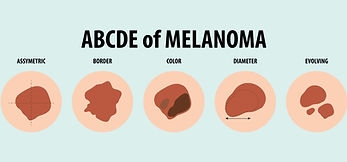
Melanoma is a more serious form of skin cancer that arises from pigment-producing cells called melanocytes.
Diagnosis typically involves clinical examination followed by an excisional biopsy to remove the lesion and confirm histology and depth (Breslow thickness), which guides treatment.
Early-stage melanomas are usually treated with wide local excision, removing the tumour with a defined margin of normal skin and a cuff of deeper tissue. For deeper or higher-risk melanomas, a sentinel lymph node biopsy may be performed to assess potential spread.
Early detection is critical, as melanoma can be life-threatening if not treated promptly. Regular skin checks are essential.
At the McIndoe Centre, we have a team of experts who diagnose and treat melanoma. Specialists from multiple disciplines collaborate through the MDT to provide expert advice and management for more complex cases.
TREATMENT OF NON-MELANOMA SKIN CANCER
First and foremost, accurate diagnosis of any lesion suspected of being skin cancer is essential. This may be made clinically or confirmed with a punch or shave biopsy to determine the type and depth of the lesion. Once confirmed as basal cell carcinoma (BCC) or squamous cell carcinoma (SCC), treatment options are discussed based on factors such as size, location, and risk of recurrence.
For pre-cancerous lesions (e.g. actinic keratoses or Bowen’s disease/SCC in situ), non-surgical treatments such as cryotherapy or topical therapies (e.g. 5-fluorouracil or imiquimod) may be suitable.
For established skin cancers, surgical treatment is usually the gold standard. The most common method is standard excision, where the cancer is removed with a margin of healthy tissue. In cosmetically or functionally sensitive areas (e.g., the face), Mohs micrographic surgery may be used, offering high cure rates with smaller margins required for removal. For deeper or more aggressive squamous cell cancer cancers, wider excision or referral for radiotherapy may be necessary.
Early detection remains key to successful outcomes